
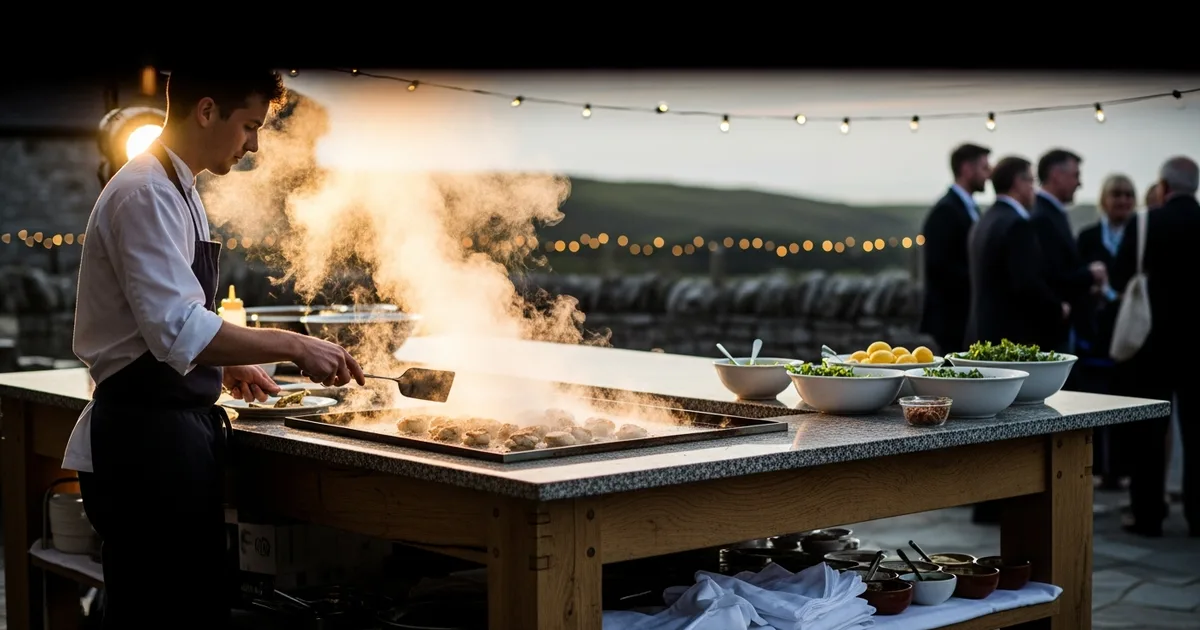
Live Cooking Site Survey Guide for Cornwall Events
Live cooking site survey for Cornwall events — vehicle access, cooking footprint, set-up windows, weather and per-cook-style pitch requirements from Salt Wind Catering.
Live cooking, BBQ, hog roast, paella, giant pan tagines, live carving, turns service into theatre. It also moves the kitchen into your venue, your garden, your field, your yard. A live-cook station that goes up smoothly is one that has been surveyed properly. If you are an event planner, venue manager, marquee coordinator, holiday-let owner or corporate event organiser, this is what Salt Wind Catering's cook team checks before we mobilise, and what we ask you to confirm before we put a deposit window in your diary.
Why a Site Survey Matters
Most catering failures on the day are not menu failures. They are access failures, pitch failures, weather failures and set-up-window failures. A 90-minute set-up does not work if the van cannot get within 80 metres of the cooking pitch. A hog roast spit cannot run on a 2.5-metre square of decking. A paella pan in an unsheltered north-facing position takes 50 per cent longer to come up to temperature in a Cornish onshore breeze.
Asking the questions before the event removes every one of those failure modes. A 20-minute phone call or a single set of venue photos saves hours on the day.
Vehicle Access — the First Question We Ask
Salt Wind Catering's cook team rolls in a long-wheelbase van with kitchen kit, gas bottles, gazebo, prep tables, refrigeration and ingredients. Before we confirm a date we need to know:
Lane width to the venue (we need 2.4 metres minimum for the van)
Any gradient that affects a loaded van
Turning circle at the end of that lane
Gate codes or keyholder contact
Whether the cooking pitch is reachable by trolley from where we can park
For lanes narrower than 2.4 metres or single-track approaches we usually shuttle in a smaller vehicle from the nearest passing place. If the venue is on a steep coastal track or a beach access, we want to know that on the call, not on the day.
What Is the Cooking Footprint by Service Style?
Different cook styles need different pitch sizes. BBQ runs from a 3-metre by 6-metre gazebo, enough room for two large grills, a prep table, a holding rack and a service line. Hog roast needs more depth because the spit and the heat shield project further: budget 4 metres by 6 metres clear, with non-flammable ground cover (gravel, paving, short grass, not decking or wood chip).
Giant pan paella and tagine work in the same 3 by 6 footprint as BBQ, with the pan stand positioned so guests can see the cooking. Live carving is the smallest, a 2-metre by 3-metre station for the chef, the joint, the board and the service plates. The pitch needs to be roughly level (no more than a 5-degree slope), reasonably firm underfoot, and clear of overhead obstructions for at least 2.8 metres.
What Power, Water and Waste Do We Need From You?
None of it. Salt Wind Catering runs fully off-grid by default. We cook on commercial LPG, with a generator carried for lighting and refrigeration when the service runs late. Water for prep and washing comes with us in food-grade containers. Waste, packaging, food scraps, used oil, cleaning water, leaves the site with us.
You do not need to find us a kitchen, a tap, a 13-amp socket or a waste connection. The only thing useful is a 13-amp socket if you happen to have one within 20 metres of the cooking pitch, which lets us hold a phone charger and a kettle going during a long set-up. If there is no socket, that is fine, the generator covers it.
How Do We Handle Wind, Weather and Gazebo Orientation?
Cornwall weather changes inside an hour. We orient gazebos with the open service side away from the prevailing wind, and we weight all four legs (45-kilo water weights minimum, sandbags in exposed coastal positions). For winds gusting above 45 mph we will not run a gazebo live cook, we either move under existing cover (barn, marquee, garage) or postpone.
Gas safety drives a lot of the survey: open-flame burners and pan stations need to be sheltered from gusts, with a clear 1-metre exclusion zone around any cooking flame and no overhanging fabric within 1.5 metres of a burner. The hog roast unit is fully enclosed and copes with weather; the paella pan is not, and a wind shield is part of our standard kit.
Set-Up Time, Cooking Time and the Service Window
Set-up runs 60 to 90 minutes before service for BBQ, paella, giant pan tagine and live carving. Hog roast set-up is the same, but cooking time is the long pole: a 30-kilo pig takes six to eight hours on the spit, so the unit is lit early morning for an evening service.
BBQ cook time: 1 to 2 hours from lighting to first portions
Paella cook time: 30 to 45 minutes from sofrito to plating
Hog roast cook time: 6 to 8 hours on the spit before carving
Live carving: joint cooked ahead and rested, sliced live across a 90-minute window
Service windows are usually 90 minutes for buffet-style live cooking, two to three hours for a continuous queue at a festival or open event.
Health and Safety — RAMS, FHR and NCASS
Salt Wind Catering carries a 5-star Food Hygiene Rating from Cornwall Council, NCASS membership, FSB membership and £10 million public liability insurance. A site-specific RAMS (Risk Assessment and Method Statement) is produced for any job involving gas appliances on a non-standard pitch, corporate events, film and TV unit bases, festivals, public-facing events.
The RAMS covers gas use, hot oil management, knife handling, manual handling, food temperature control, waste disposal, fire safety and crew interaction with guests or other site staff. Venue managers can request it ahead of the event for their own records. For utility and contractor work, the welfare-grade documentation is described in our welfare catering procurement guide.
BBQ Pitch Requirements
Two large grills running side by side, a prep table, a service line and an under-bench cool box for raw protein. Footprint 3m x 6m, level ground, non-flammable surface within 1 metre of the grills. Ideal positioning: open service side facing the guests, with a 2-metre buffer between the cook line and the nearest dining area.
Hog Roast Pitch Requirements
The spit unit is roughly 2 metres long and 1 metre deep, sitting on its own wheels. It needs 4 metres of clear length to allow for the carving table at the front and the gas supply at the rear, and 2 metres of width for the chef working position. Six to eight hours of cooking time before service.
No overhanging tree canopy, no decking under the unit, no wooden gazebo legs within 1.5 metres of the heat box. The aroma drifts, site the unit downwind of any seated dining if the wedding party is sensitive to smoke.
Giant Pan, Paella and Tagine Pitch Requirements
A metre-wide paella pan over a triple-ring burner, with a wind shield around the burner base. The chef cooks live in front of the queue, so the pan is positioned at chest height on a sturdy stand. Footprint 3m x 6m including the prep table and the service line. The visual is part of the food, site the pan where guests can watch it.
What Does a Live Carving Station Need?
Carving runs from a small footprint, 2m x 3m for the chef, the joint, the board, the service plates. Chef carves direct to plate or to a sharing platter. There is no waiter, Salt Wind Catering is a cook team, not a front-of-house service. The carving station goes wherever the queue can reach it: end of the buffet line, beside the main course station, or as a standalone feature.
What We Do Not Need From the Venue
Mains power, we run on commercial LPG and a generator
Mains water, we carry our own in food-grade containers
Indoor kitchen access, all cooking is done from the live station
Front-of-house waiting staff, Salt Wind Catering is a cook team only
Crockery, cutlery and glassware, compostable disposables on request only
Drinks or bar service, not part of the Salt Wind Catering offer
What Are the Risk Factors and How Do We Mitigate Them?
The four risks we plan for:
Weather (gazebo failure or wind-driven flame disturbance), mitigated by wind shields, weights and documented abort criteria
Access (van blocked or pitch unreachable), mitigated by pre-event site visit or detailed photos
Gas supply (running out mid-service), mitigated by carrying twice the cylinders we need
Timing (set-up window too short), mitigated by arriving 90 minutes early as default
For events on cliffs, beaches, moorland or any pitch outside a fenced venue we walk it in person before the event. For contractor and welfare-grade work we follow the documented procedures described in the welfare catering procurement guide.
Frequently Asked Questions
Do you need a kitchen at the venue?
No. Salt Wind Catering operates fully off-grid by default. Gas, water and waste containment travel with the cook team. The venue does not need to provide kitchen access, a tap or a power supply.
How much space does a hog roast pitch need?
4 metres by 6 metres of clear, level, non-flammable ground. The spit unit itself sits in a 2m x 1m footprint, with carving and prep space in front and gas supply behind. No decking, no overhanging tree canopy.
How early do you arrive before service?
60 to 90 minutes for BBQ, paella, giant pan and live carving. Hog roast is lit five to seven hours before service depending on the size of the pig. We confirm the exact arrival window with the venue manager 48 hours before the event.
What if the weather turns?
For winds above 45 mph or a sustained electrical storm we will not run a live gazebo cook. We either move the station under existing cover or, for film and TV unit bases, we run from the standby vehicle. Decision points are confirmed with the planner the morning of the event.
Do you provide waiting staff?
No. Salt Wind Catering is a cook team, chefs cook and serve direct to the plate, the queue or the sharing platter. For events that need formal front-of-house service the planner books the waiting staff separately.
Do you supply crockery, cutlery and glassware?
No. We supply compostable disposables on request for paella, tagine and BBQ. For events with hire crockery or in-house tableware we plate to your service stack. Glassware and bar service are not part of the Salt Wind Catering offer.
Do you need a risk assessment from us?
No. Salt Wind Catering produces a site-specific RAMS for any event involving gas appliances on a non-standard pitch. The document is available to share with the venue or principal contractor on request.
What ground surface works for the pitch?
Flat, firm and non-flammable. Paving, gravel, short grass and compacted earth all work. Decking and wood chip do not work under a hog roast or open burner. Steeply sloping ground (over 5 degrees) is not workable for any live cook.
Related Salt Wind Catering Services
Live cooking sits at the heart of our service offer. See BBQ catering Cornwall, hog roast catering Cornwall and giant pan catering Cornwall for the per-service pages with menus and starting prices.
Get a Live Cooking Quote
To talk through a live cooking event at your Cornwall or Devon venue, call 01209 206255 or email info@saltwind.catering. Salt Wind Catering, based in Redruth.
Planning an event?
Get a free, no-obligation catering quote from Salt Wind Catering. Buffets, BBQs, hog roasts and more across Cornwall and Devon.
Written by the Salt Wind Catering kitchen team from our base in Redruth, Cornwall. Our guides, pricing notes and recipes come from events we have actually catered across Cornwall and Devon — corporate lunches, welfare meals on site, hog roasts, film-unit catering — and every piece is checked against how we really work before it is published.
Salt Wind Catering content is written by our team under fictional personas to reflect each catering specialism. About us.
More from the kitchen
How We Catered Two Rosamunde Pilcher Films Across Cornwall
A behind-the-scenes case study: how Salt Wind Catering catered two back-to-back Rosamunde Pilcher feature film...
Off-Grid Film Catering: Feeding Crews on Remote Cornwall & Devon Locations | Salt Wind Catering
Our self-contained mobile kitchen carries its own LPG appliances, generators, water, refrigeration and waste —...
How Far Ahead Should You Book a Film & TV Caterer in Cornwall? | Salt Wind Catering
Book your location caterer as soon as shoot dates and unit base are confirmed — 3–6 weeks for a standard shoot...