
Wake Catering at a Cornish Village Hall: A Practical Guide
Aim for the buffet to be on the table before mourners arrive from the service. That usually means a 60 to 90 minute set-up window between the caterer arriving and the first guests walking in. Confirm the hall key holder, kitchen access and bin arrangement in advance. Most Cornish village halls are simple, well-loved spaces and the people who run them will quietly help you.
Most Cornish villages still hold their wakes the old way. The service is at the parish church or the crematorium at Penmount or Glynn Valley, and the gathering afterwards is at the village hall a short walk or drive away. If you have been asked to organise one, this guide covers the practical side: timing, access, what the hall provides, what the caterer provides, and the small unwritten rules that make these days run smoothly.
Timing relative to the service
The standard sequence is: service at the church or crematorium, brief gathering at the graveside if there is a burial, then onward to the village hall. The travel time between the two is the planning variable. For most Cornish villages, allow 30 to 45 minutes between the service ending and guests arriving at the hall. The caterer should arrive 90 minutes before that, so for a midday service expect the caterer on site between 11:30 and 12:00.
Set-up windows and hall booking
Village halls are usually booked by the half day. A morning slot typically runs 09:00 to 13:00, an afternoon slot 13:00 to 17:00 or 18:00. For a service at midday, an afternoon-only hall booking is too tight. Book the hall from the morning, so we have time to set up, the tables can be laid, and the family can arrive to a ready room rather than catering in motion. The extra half-day cost is usually small, often £25 to £50 depending on the hall.
Key holder and access
Every Cornish village hall is run by a voluntary committee, and there will be one named key holder who lets the caterer in. Get their name and mobile number when you book the hall. We will call them on the morning of the wake to confirm arrival. If the key holder is unavailable, ask the committee for a backup. A locked hall and a caterer waiting outside is the avoidable problem we see most often.
Kitchen, crockery and what the hall provides
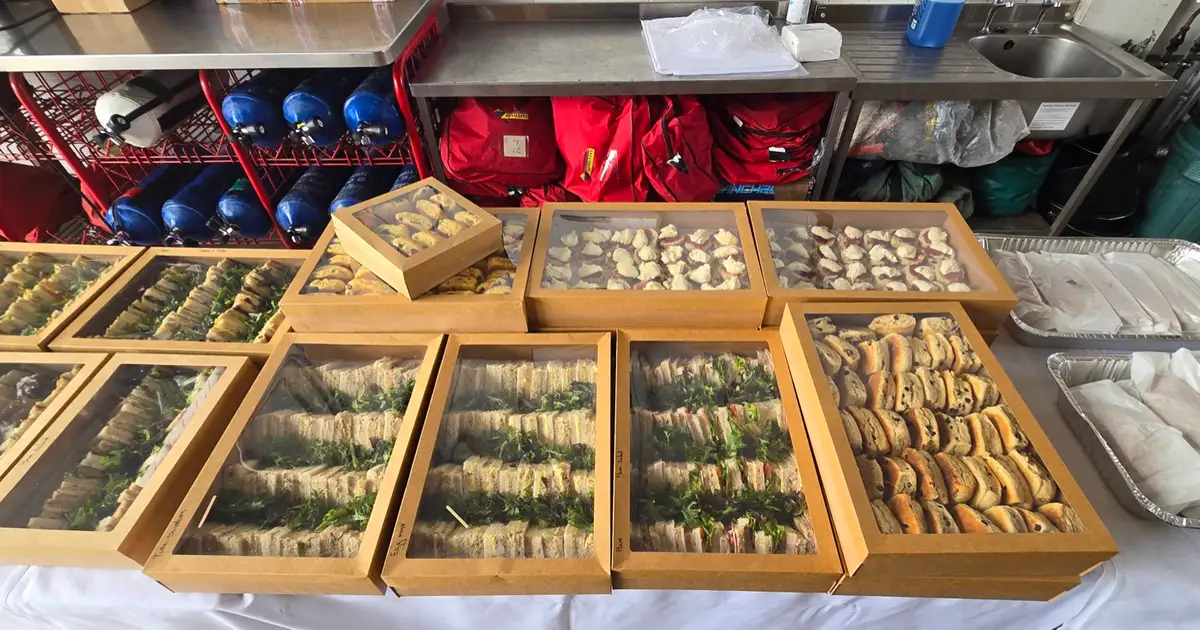
Most Cornish village halls have a small kitchen with a domestic-sized fridge, a tea urn, a kettle and basic crockery. We do not rely on any of this. Our buffets arrive ready to serve in eco-friendly stackable boxes, and our hot food arrives in thermal containers. We do not use the hall fridge, oven or dishwasher. We do appreciate access to a sink for a quick wipe-down of trestle tables before laying out.
We do not provide crockery, plates, cups or cutlery. We do not provide tableware hire of any kind. Most Cornish village halls have a basic set of plates and cups that comes with the hire, and that is usually enough. If the hall does not, disposable plates and cups are acceptable for a wake and most village shops or the Co-op in the nearest town will stock packs of 50.
Accessibility for elderly guests
Most Cornish village halls have step-free access, but not all. If you have elderly or less mobile guests, check three things: the entrance is step-free or has a permanent ramp, there is a downstairs toilet, and there are chairs available for guests who cannot stand for long. Wakes run for two to three hours and people do not all sit down to eat. Plenty of seating around the edges of the room is the kindest thing.
What villagers expect
In a small Cornish village, the wake at the hall is a community moment as well as a family one. The neighbour who looked in on the deceased every week, the postmaster, the choir, the bowls club, the Methodist chapel steward. Expect more people than the immediate family circle. Add 10 to 20 percent to your headcount if the deceased was a long-standing member of village life. Plan the food slightly over, never under.
Who handles what on the day
The funeral director arranges the service, the cars and the order of the day. The family chooses the readings, the music and the hall. The hall committee provides the venue, the key and the basic facilities. The caterer delivers the food and tea. Someone in the family or a trusted friend should be the point of contact on the day, so the caterer is not asking the bereaved spouse where to put the sandwich platters. Designate that person in advance.
Our arrival, departure and clearing up
Wake buffets are always drop-and-go. We deliver, we set out the spread on the trestle tables, we set up the tea and coffee station, and then we leave before guests arrive. The cook team is not present during the wake itself. This is deliberate. A wake is a family moment, not a catered event with staff in attendance. We have learned the value of robust, reliable service in difficult circumstances, including from our work in emergency welfare during Storm Goretti across rural Cornwall.
Leftover food goes home with family in the boxes we provide. The hall committee will expect the room left as it was found: tables wiped, bins emptied to the outside bin store, floor swept. Allocate two or three friends or younger family members to handle this in the last 15 minutes. Most halls take a deposit against cleaning, refundable when the key is returned.
If you are reading this with a notepad and a half-cold cup of tea, you are doing fine. Call us on 01209 206255 if you want to talk through any of it. We have done a lot of these and we know the difference between a useful question and an unnecessary one.
Frequently asked questions
How long does a wake at a Cornish village hall last?
Two to three hours is the standard window, starting around 45 minutes after the service ends. People come and go across the afternoon rather than all arriving at once.
Do I need to book the hall for a full day?
Usually yes. An afternoon-only slot is too tight for catering set-up. Book from the morning so the caterer has time to lay out the spread and the family arrives to a ready room.
Does Salt Wind Catering provide staff or crockery?
No. We do not provide serving staff, waiting staff or front-of-house at any size. We do not provide crockery, plates, cups or cutlery. Most village halls include basic tableware in the hire. See our allergen and dietary notes for dietary detail.
Who cleans up afterwards?
The family. Allocate two or three friends or younger family members in the last 15 minutes to wipe tables, empty bins and sweep the floor. Hall committees usually take a refundable cleaning deposit.
Can you cater wakes in remote Cornish villages?
Yes. We cover all of Cornwall and into Devon from our base in Redruth. A small travel supplement may apply for the furthest corners. Call 01209 206255 to confirm.
Related reading
Planning an event?
Get a free, no-obligation catering quote from Salt Wind Catering. Buffets, BBQs, hog roasts and more across Cornwall and Devon.
Written by the Salt Wind Catering kitchen team from our base in Redruth, Cornwall. Our guides, pricing notes and recipes come from events we have actually catered across Cornwall and Devon — corporate lunches, welfare meals on site, hog roasts, film-unit catering — and every piece is checked against how we really work before it is published.
Salt Wind Catering content is written by our team under fictional personas to reflect each catering specialism. About us.
More from the kitchen
How We Catered Two Rosamunde Pilcher Films Across Cornwall
A behind-the-scenes case study: how Salt Wind Catering catered two back-to-back Rosamunde Pilcher feature film...
Off-Grid Film Catering: Feeding Crews on Remote Cornwall & Devon Locations | Salt Wind Catering
Our self-contained mobile kitchen carries its own LPG appliances, generators, water, refrigeration and waste —...
How Far Ahead Should You Book a Film & TV Caterer in Cornwall? | Salt Wind Catering
Book your location caterer as soon as shoot dates and unit base are confirmed — 3–6 weeks for a standard shoot...